Friday, November 18, 2011
Louis Daguerre Daguerreotype Ten Steps Process
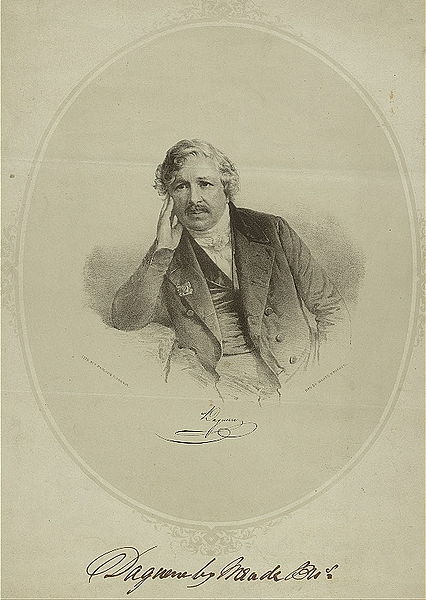
Louis Jacques Mande DAGUERRE (1787-1851)
The daguerreotype process was the first practicable method of obtaining permanent images with a camera. The man who gave his name to the process and perfected the method of producing direct positive images on a silver-coated copper plate was Louis Jacques Mande Daguerre, a French artist and scenic painter. Daguerre had began experimenting with ways of fixing the images formed by thecamera obscura around 1824, but in 1829 he entered into partnership with Joseph Nicephore Niepce(1765-1833), a French amateur scientist and inventor who, in 1826, had succeeded in securing a picture of the view from his window by using a a camera obscura and a pewter plate coated with bitumen. Niepce called his picture-making process heliography ("sun drawing"), but although he had managed to produce a permanent image using a camera, the exposure time was around 8 hours. Niepce later abandoned pewter plates in favour of silver-plated sheets of copper and discovered that the vapour from iodine reacted with the silver coating to produce silver iodide, a light sensitive compound.
After the death of Niepce in 1833, Daguerre continued to experiment with copper plates coated with silver iodide to produce direct positive pictures. Daguerre discovered that the latent image on an exposed plate could be brought out or "developed" with the fumes from warmed mercury. The use ofmercury vapour meant that photographic images could be produced in twenty to thirty minutes rather than hours. In 1837, Daguerre found a way of "fixing" the photographic images with a solution of common salt. Two years later, he followed the suggestion of Sir John Herschel (1792-1871) and adopted hyposulphate of soda (now thiosulphate of soda ) as the fixing agent.
Daguerre began making successful pictures using his improved process from 1837. On 19th August,1839, at a meeting in Paris, the Daguerreotype Process was revealed to the world.
In England, Richard Beard (1801-1885), a former coal merchant and patent speculator, bought the patent to Alexander Wolcott's mirror camera and employed the services of John Frederick Goddard (1795-1866), a chemist, to find a way of reducing exposure times to less than a few minutes, thereby making it possible to take daguerreotype portraits. On 23rd March 1841, Richard Beard opened England’s first daguerreotype portrait studio in London's Regent Street. In June 1841, Beard purchased from Daguerre the patent rights to the daguerreotype process in England.
Ten Steps in Making a Daguerreotype Process
1. Polishing and Buffing the Photographic Plate
A plate of silver-coated copper is cleaned and highly polished with a soft cloth, using pumice powder and oil. The plate is continually polished and buffed until the silvered surface has a mirror-like brilliance.
2. Sensitizing the Photographic Plate
The polished plate is sensitized by exposing it to iodine and bromine fumes. The plate is first suspended in an air tight compartment containing chloride of iodine until the surface of the silvered plate turns yellow. The iodized plate is then suspended face down over chloride of bromine fumes. The two chemicals combine with the silver coating of the plate to form a light sensitive surface. ( Some daguerreotype artists used a combination of chlorine and iodinevapours ).
3. Loading the Camera
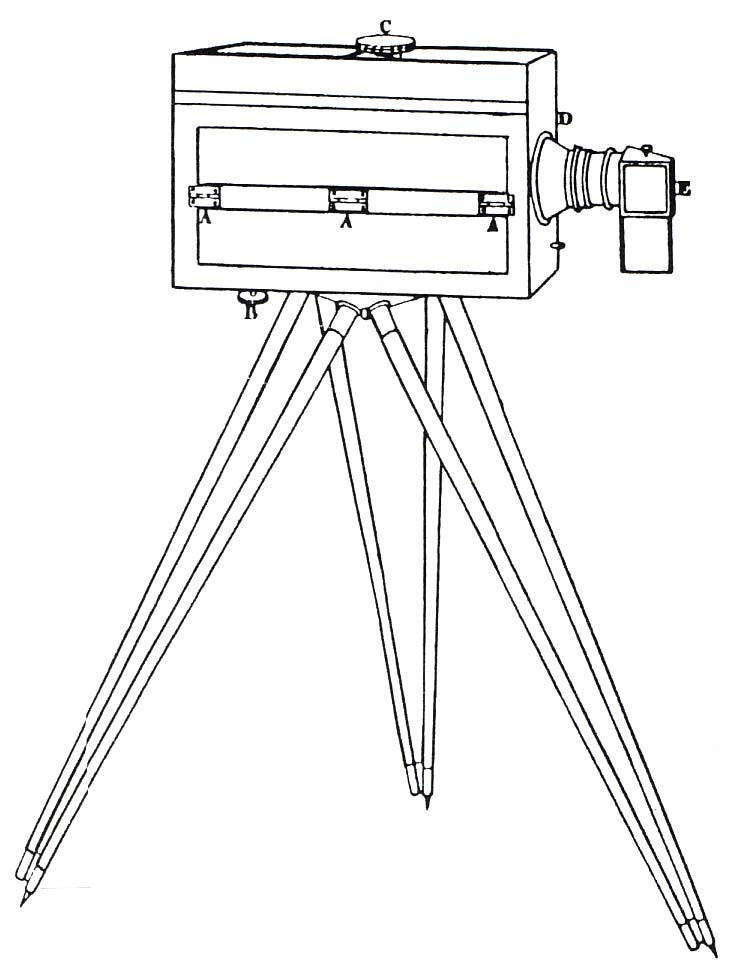
The sensitized plate is inserted into alight-proof holder with a protective slide and placed inside the camera.
4. Taking the Likeness
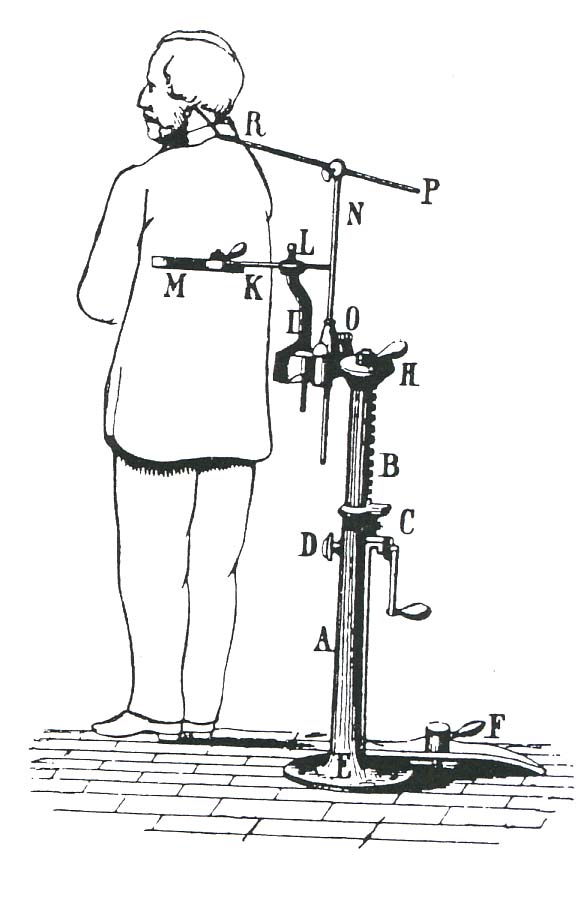
The subject is placed in front of the camera. If necessary, the pose is held with the assistance of adjustable head rests, clamps and posing stands.
The protective slide is removed and, when the photographer is satisfied with the pose and expression of the sitter, the lens cap is removed for a period of time until the image is captured on the sensitized surface of the plate.
5. Developing the Image
The image is "brought out" by suspending the photographic plate over a dish of mercury inside afuming box. The mercury is heated by a spirit lamp and the fumes from the mercury combine with the silver salts to produce a clear image on the plate.
6. Fixing the Image
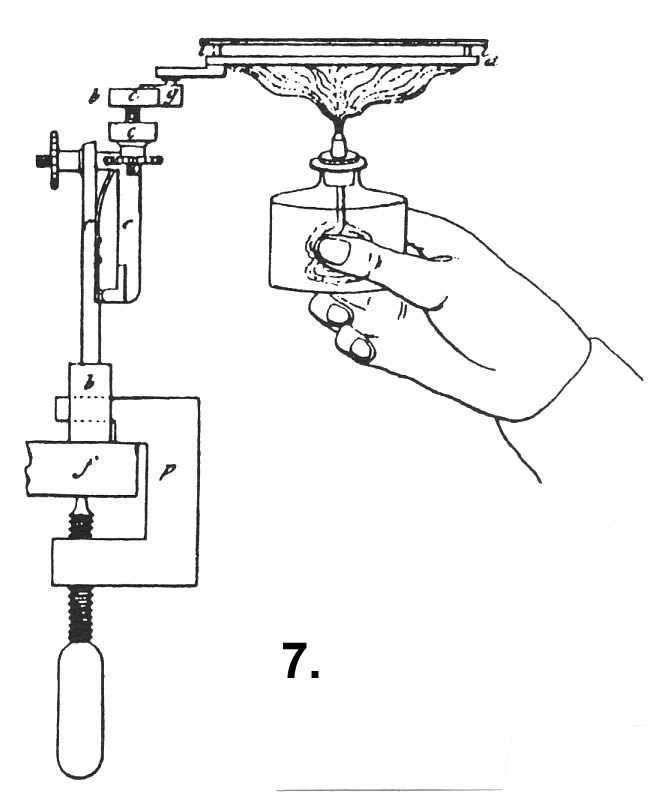
| Fixing the image with hyposulphate of soda |
The photographic image is made permanent by bathing the photographic plate in hyposulphate of soda ( or sodium thiosulphite ).
7. Gold Toning or Gilding ( optional )
The image on the the photographic plate can also be toned and strengthened by treating the plate with gold chloride
8. Washing the Photographic Plate
Finally, the photographic plate is washed in distilled water and dried.
9. Colouring ( optional )
The portrait could be coloured by hand. The surface of the plate was coated with a thin film of gum arabic and left to dry. The colourist would then breathe on the treated plate to make it sticky and with a fine paintbrush applied dry powdered pigment to the image.
10. Mounting and Presenting the Finished Daguerreotype Portrait
The finished daguerreotype portrait was surrounded by a gilt or brass mat, covered with a sheet of protective glass, and bound in a metal frame. The daguerreotype portrait was presented in a velvet or plush-lined, leather case, or mounted in a decorative frame.
Louis Daguerre Daguerreotype
History and Development of Forensic Science up to the 20th Century
Key People
- Fortunatus Fidelis- first person to practice forensic medicine
- Sir Francis Galton- developed first basic system for classifying fingerprints based on grouping the patterns into arches, loops, and whorls
- Alphonse Bertillion- French criminologist who applied techniques of human body measurement used in anthropological classification to the identification of criminals
- Zacharias Janssen- Dutch lens-maker who invented first compound microscope
- Louis Daguerre- first photograph- "daguerreotype"
Mathieu Orfila- “Father of Toxicology,” wrote Traite des Poisons
- William Talbot- invented the photographic negative
- Henry Goddard- first to trace bullet back to gun successfully
- Cesare Lombroso- said criminals had certain physical features
- Francesco Patrizi- made early type of lie detector that failed

Key Terms
- Forensic medicine- application of medical knowledge to legal questions
- Compound microscope- microscope with more than one lens

- Forensic science- scientific method of collecting and gathering evidence.
![]() |
| Mathieu Orfila |
Case Study
France, 1840: A 24-year-old woman named Marie Lafarge was charged with poisoning her husband. She had been seen buying arsenic "to kill her rats" and it was also rumored that she was unhappy with her marriage. Lawyers on both sides were arguing and the methods scientists used to prove that Lafarge had killed her husband kept being doubted or disproved. Both sides agreed to consult Mathieu Orfila, "Father of Toxicology." Orfila took samples from the husband's body and the soil that he was buried in. Orfila found traces of arsenic in the body and proved that it did not come from the surrounding soil, making the jury decide that Lafarge was guilty and she was sentenced to life in jail.
Source; northcrossschoolforensics.wikispaces.com
Louis Daguerre Daguerreotype Process
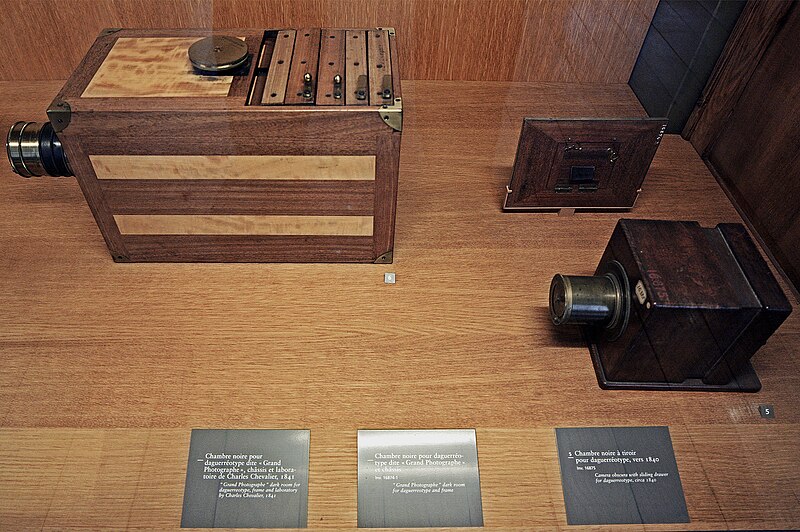
| 1840-1841 Camerae obscurae and plates for Daguerreotype called "Grand Photographe" produced by Charles Chevalier (Musée des Arts et Métiers). |
The mercury vapour condensed on those places on the plate where the exposure light was most intense (highlights), and less so in darker areas of the image (shadows). This produced a picture in an amalgam, the mercury washing the silver out of the halides, solubilizing and amalgamating it into free silver particles which adhered to the exposed areas of the plate, leaving the unexposed silver halide ready to be removed by the fixing process. This resulted in the final unfixed image, which consisted of light and dark areas of grey amalgam on the plate. The developing box was constructed to allow inspection of the image through a yellow glass window to allow the photographer to determine when to stop development.
The next operation was to "fix" the photographic image permanently on the plate by dipping in a solution of hyposulphite of soda, often called "fixer" or "hypo", to dissolve the unexposed halides. Initially, Daguerre's process was to use a saturated salt solution for this step, but later adopted Herschel's suggestion of sodium thiosulphate, as did W. H. F. Talbot.
The image produced by this method is extremely fragile and susceptible to damage when handled. Practically all daguerreotypes are protected from accidental damage by a glass-fronted enclosure. It was discovered by experiment that treating the plate with heated gold chloride both tones and strengthens the image, although it remains quite delicate and requires a well-sealed enclosure to protect against touch as well as oxidation of the fine silver deposits forming the blacks in the image. The best-preserved daguerreotypes dating from the 19th century are sealed in robust glass cases evacuated of air and filled with a chemically inert gas, typically nitrogen.
Daguerreotype Proliferation
André-Adolphe-Eugène Disdéri and Jules Itier in France, and Johann Baptist Isenring in Switzerland, became prominent daguerreotypists. In the United Kingdom, however, Richard Beard bought the British daguerreotype patent from Miles Berry in 1841 and closely controlled his investment, selling licenses throughout the country and prosecuting infringers.Among others, Antoine Claudet andThomas Richard Williamsproduced daguerreotypes in the U.K.
Daguerreotype photography spread rapidly across the United States. In the early 1840s, the invention was introduced in a period of months to practitioners in the United States by Samuel Morse, inventor of the telegraph code. One of these original Morse Daguerreotype cameras is currently on display at the National Museum of American History, a branch of the Smithsonian, in Washington, DC. A flourishing market in portraiture sprang up, predominantly the work of itinerant practitioners who traveled from town to town. For the first time in history, people could obtain an exact likeness of themselves or their loved ones for a modest cost, making portrait photographs extremely popular with those of modest means. Notable U.S. daguerreotypists of the mid-19th century included James Presley Ball,Samuel Bemis,Abraham Bogardus,Mathew Brady,Thomas Martin Easterly,François Fleischbein, Jeremiah Gurney, John Plumbe, Jr.,Albert Southworth, Augustus Washington, Ezra Greenleaf Weld,] and John Adams Whipple.
This method spread to other parts of the world as well. In 1857, Ichiki Shirō created the first knownJapanese photograph, a portrait of his daimyo Shimazu Nariakira. This photograph was designated anImportant Cultural Property by the government of Japan.
The daguerreotype is commonly, erroneously, believed to have been the dominant photographic process into the late part of the 19th century in Europe. Evidence from the period shows that it was in widespread use for less than twenty years before being superseded by other processes:
- The calotype, introduced in 1841; a negative-positive process using a paper negative.
- The collodion wet plate process, introduced in 1851; a negative-positive process using halide-impregnated collodion poured from a bottle onto a glass plate and sensitized by immersion in a silver nitrate bath.
The collodion wet plate process was used to produce ambrotypes on glass and tintypes or ferrotypes on a coated iron plate.
- The ambrotype, introduced in 1854; a negative image on glass which appeared positive when on dark "ruby" glass or backed with a black varnish or cloth.
- The tintype or ferrotype, introduced in 1856; an image like the ambrotype, but on a thin blackened iron plate instead of glass.
Daguerreotype Demise
The intricate, complex, labor-intensive daguerreotype process itself helped contribute to the rapid move to theambrotype and tintype. The proliferation of these simpler and much less expensive photographic processes made the costly daguerreotypes less appealing to the average person (although it remained very popular inastronomical observatories until the invention of glass plate cameras). According to Mace (1999), the rigidity of these images stems more from the seriousness of the activity than a long exposure time, which he says was actually only a few seconds (Early Photographs, p. 21). The daguerreotype's lack of a negative image from which multiple positive "prints" could be made was a limitation also shared by the tintype, but was not a factor in the daguerreotype's demise until the introduction of the calotype. The fact that many of those to use the process suffered severe health problems or even death from mercury poisoning after inhaling toxic vapors created during the heating process also contributed to its falling out of favor with photographers. Unlike film and paper photography however, a properly sealed daguerreotype can potentially last indefinitely.
The daguerreotype's popularity was not threatened until photography was used to make imitation daguerreotypes on glass positives called ambrotypes, meaning "imperishable picture" (Newhall, 107).
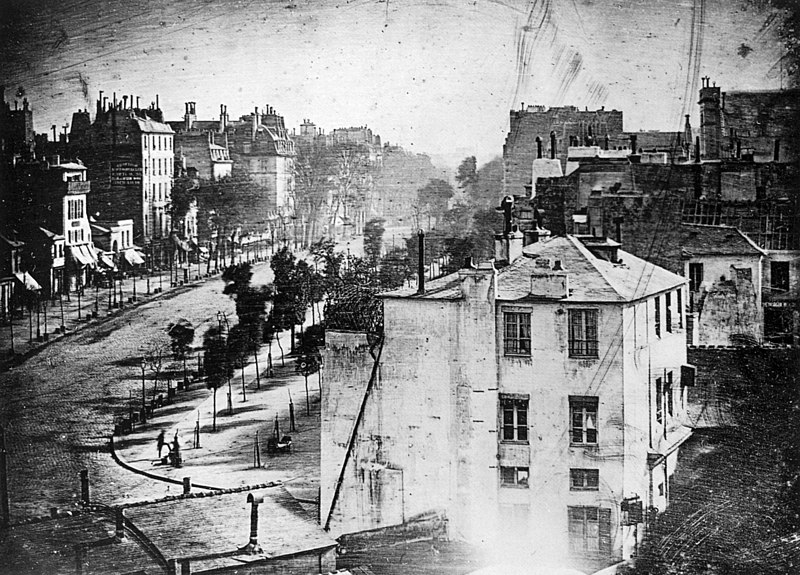
Boulevard du Temple by Daguerre |
Boulevard du Temple, Paris, 3rd arrondissement, Daguerreotype. The purportedly first picture of a living person. The image shows a busy street, but due to exposure time of more than ten minutes, the traffic was moving too much to appear. The exceptions are the two people at the bottom left, one who stood still getting his boots polished by the other long enough to show. Look closely and you will also see another man sitting on a bench to the right reading a newspaper. Also in the upper left hand side you can also see another man standing under the awning of the 3rd building from the left. What looks to be a woman standing under the street lantern at 10 o'clock from the man getting his shoes shined and another one in the big white building,1st row 3rd window down. Notice the child in the top floor window of the white building in front. Note that the image is a mirror image.
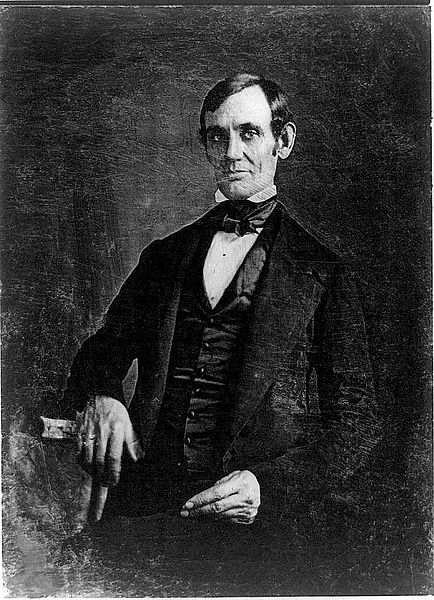
The first authenticated image ofAbraham Lincoln was this daguerreotype of him as U.S.Congressman-elect in 1846, attributed to Nicholas H. Shepard of Springfield, Illinois.
Andrew Jackson-1844 |
Daguerreotype of Andrew Jackson at age 77 or 78 (1844 or 1845).
| A daguerreotype of Shimazu Nariakira, taken by Ichiki Shiro (1828 - 1903) |
| Photo panorama of San Francisco, 1853 |
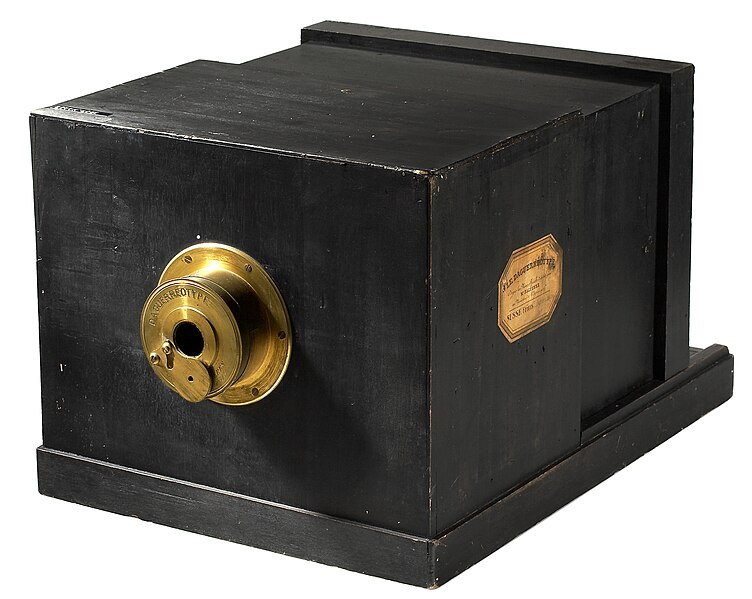
Susse Frére Daguerreotype camera 1839 |
First Daguerreotype Invention and Photographs
The daguerreotype (French: daguerréotype) was the first commercially successful photographic process. The image is a direct positive made in the camera on a silvered copper plate. The raw material for plates was called Sheffield plate, plating by fusion or cold-rolled cladding and was a standard hardware item produced by heating and rolling silver foil in contact with a copper support. The surface of a daguerreotype is like a mirror, with the image made directly on the silvered surface; it is very fragile and can be rubbed off with a finger, and the finished plate has to be angled so as to reflect some dark surface in order to view the image properly. Depending on the angle viewed, and the color of the surface reflected into it, the image can change from a positive to a negative.
First Daguerreotype Invention Invention
Since the late Renaissance, artists and inventors had been looking for a mechanical method of capturing visual scenes.Previously, using the camera obscura, artists would manually trace what they saw, or use the optical image in the camera as a basis for solving the problems of perspective and parallax, and deciding colour values. The camera obscura's optical reduction of a real scene in three-dimensional space to a flat rendition in two dimensions influenced western art, so that at one point, it was thought that images based on optical geometry (perspective) belonged to a more advanced civilization. Later, with the advent of Modernism, the absence of perspective in oriental art from China, Japan and in Persian miniatures was revalued.
Previous discoveries of photosensitive methods and substances—including silver nitrate by Albertus Magnus in the 13th century, a silver and chalk mixture by Johann Heinrich Schulze in 1724, and Joseph Niépce's bitumen-based heliography in 1822 —contributed to development of the daguerreotype. In 1829 French artist and chemist Louis J.M. Daguerre, contributing a cutting edge camera design, partnered with Niépce, a leader in photochemistry, to further develop their technologies.
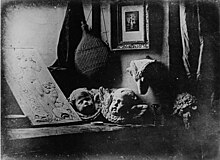
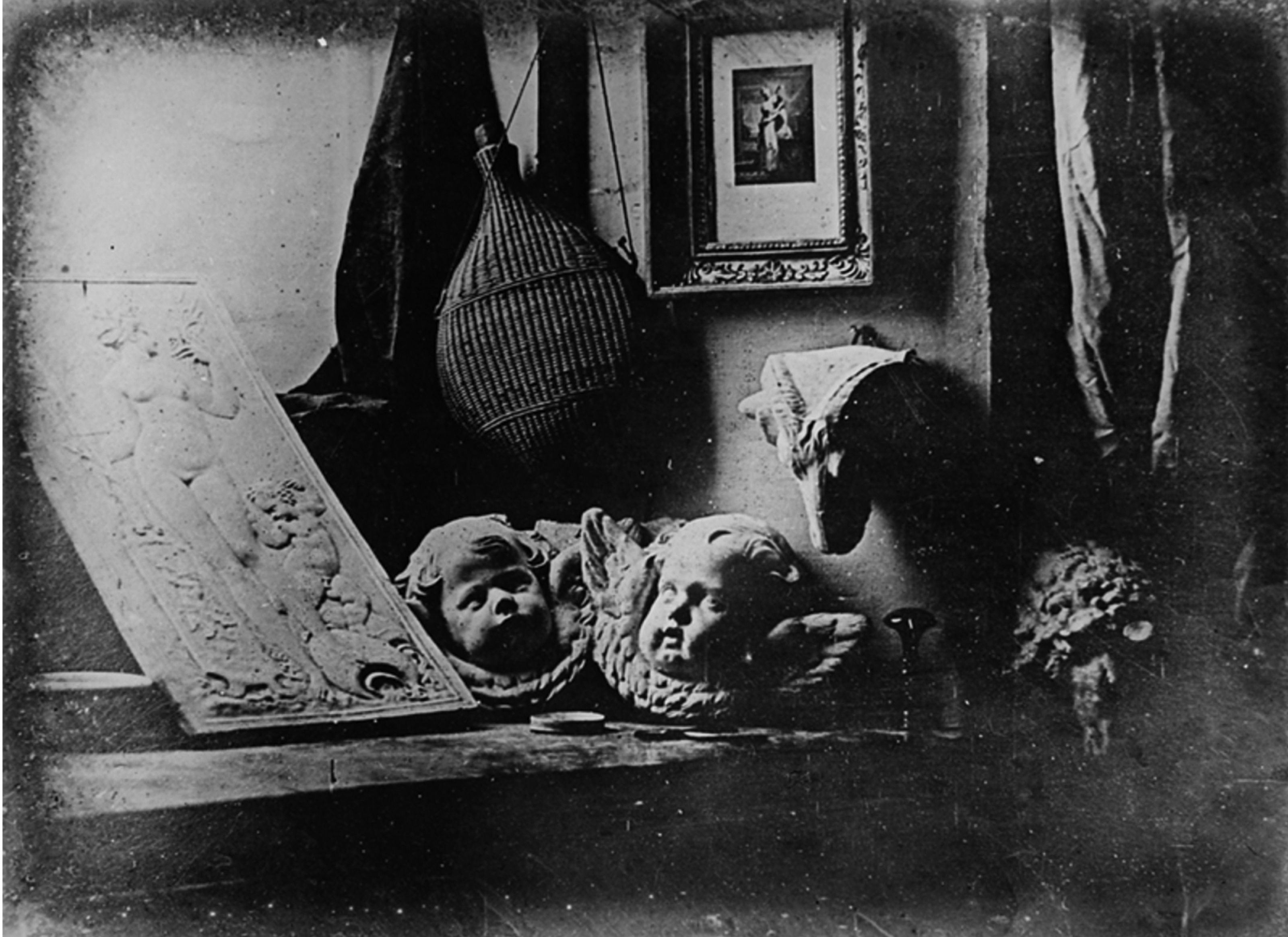
After Niépce's 1833 death, Daguerre continued to research the chemistry and mechanics of recording images by coating copper plates with iodized silver.Early experiments required hours of exposure in the camera to produce visible results. In 1835 Daguerre discovered—after accidentally breaking a mercury thermometer, according to traditional accounts—a method of developing the faint or invisible images on plates that had been exposed for only 20 to 30 minutes. Further refinement of his process would allow him to fix the image—preventing further darkening of the silver—using a strong solution of common salt. The 1837 still life of plaster casts, a wicker-covered bottle, a framed drawing and a curtain—titled L'Atelier de l'artiste—was his first daguerreotype to successfully undergo the full process of exposure, development and fixation.
The French Academy of Sciences announced the daguerreotype process on January 9, 1839. Later that year William Fox Talbot announced his silver chloride "sensitive paper" process. Together, these announcements mark 1839 as the year photography was born.
Daguerre did not patent and profit from his invention in the usual way. Instead, it was arranged that the French government would acquire the rights in exchange for a lifetime pension. The government would then present the daguerreotype process "free to the world" as a gift to mankind, which it did on August 19, 1839. However, on August 14, 1839, Miles Berry, acting on Daguerre's behalf, filed for a patent in England, which consequently became the only place on Earth where the purchase of a license was legally required.
1840-1841 Camerae obscurae and plates for Daguerreotype called "Grand Photographe" produced by Charles Chevalier (Musée des Arts et Métiers).
Daguerreotype Daguerre Atelier 1837 |
L'Atelier de l'artiste. An 1837 daguerreotype by Daguerre, the first to complete the full process.
| The solar eclipse of July 28, 1851 is the first correctly exposed photograph of a solar eclipse, using the daguerreotype process. |
Description ;Berkowski made the first solar eclipse photograph on July 28, 1851, also using the daguerrotype process, at the Royal Observatory in Königsberg, Prussia (now Kalinigrad in Russia). Berkowski, a local daguerrotypist whose first name was never published, observed at the Royal Observatory. A small 6-cm refracting telescope was attached to the 15.8-cm Fraunhofer heliometer and a 84-second exposure was taken shortly after the beginning of totality.
The graphic art of printmaking, unlike many other media ,allows for the multiple reproduction of an image. Artists have long used printmaking to create illustrated books and popular artworks meant to reach a wide audience-printing with moveable type developed in China in the eleventh century and in Europe in the fifteenth century. There are many different printmaking techniques, each producing distinctive visual effects.
![]() |
| Wood Cut Graphic Art |
![]() |
| Engraving Graphic Art |
![]() |
| Etching Graphic Arts |
![]() |
| Lithography Graphic Arts |
- woodcut: The design is carved into a wood block. The cut-away areas and lines appear white on the print. Extremely fine lines are difficult to achieve, because the wood will split if cut too finely.
- engraving: The engraver cut lines into a metal plate using a special tool called a burin. The lines are sharp and clear , and often finer than those achieved with woodcut.
- etching: The etcher covers a metal plate with a wax ground and then draws in it with a blunt needle. The plate is dipped in an acid bath, which eats away the exposed areas of the metal. These lines then hold the ink for printing. Etched lines are typically looser and freer than engraved lines.
Honour to Louis Daguerre's 224th birthday By Google Doodle
Google welcomed users with a family photo doodle in honour of Louis-Jacques-Mandé Daguerre's 224th birthday. The French painter and physicist was the inventor of daguerreotype, the first successful form of photography.
Before the daguerreotype, photography required hours of exposure and Louis Daguerre's invention reduced it to 20-30 minutes.
In the daguerreotype process, a technique developed by Daguerre in collaboration with Nicephore Niepce in the 1830s, a silver iodide coated copper plate was exposed to light in a camera and then was fumed with mercury vapour. Then a solution of common salt was applied to form a permanent image. As the daguerreotype grew popular, later improvements shortened the exposure time to forty seconds by 1841.
Daguerre died of a heart attack on July 10, 1851.
The Daguerre Google doodle shows a family of five in a 19th century style family photo, where the 'G' and 'O' of the Google name depict the father and the mother and the remaining three letters the children. The 'Os' are the two daughters and 'E' the son. The 'L' is the lamp. Interestingly the father 'G' bears a resemblance to Daguerre himself.
Google doodles have gained immense popularity over the past few years and the Google team has put out commemorative doodles on events ranging from news events, civic milestones, birthdays, death anniversaries and important dates in history.
Google estimates it has created more than 900 doodles since 1998, with 270 of them running in 2010 and about 200 in 2011.


Posted in: